
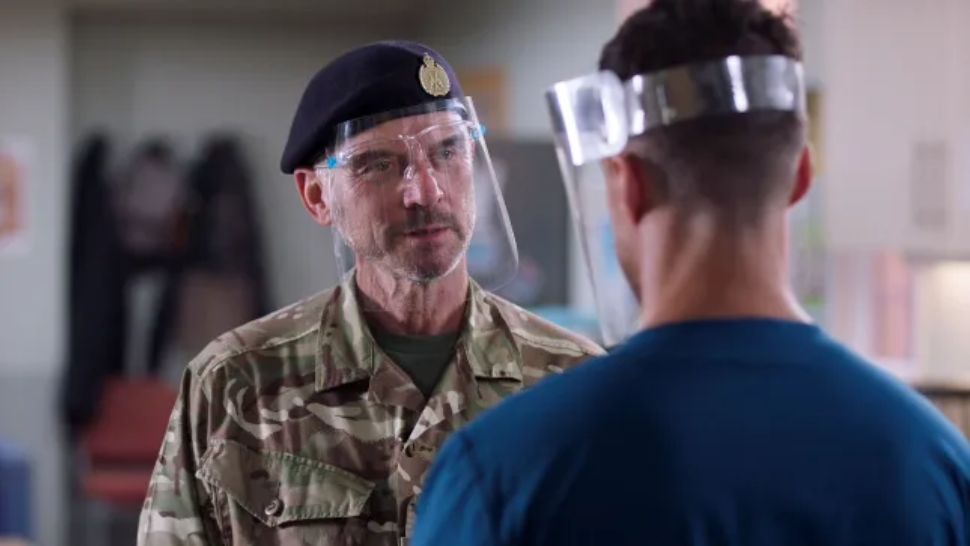
Will Colonel Bard Finally Pay for His Crimes? Inside Flynn’s Fight for Justice
Fans of Casualty are on the edge of their seats this season as one of the show’s most chilling antagonists, Colonel Jack Bard, remains at the centre of a storyline that blends moral outrage, personal loss, and the pursuit of justice. With revelations of abuse, hazing and devastating emotional fallout, Casualty has turned its spotlight from clinical drama to the psychological and ethical consequences of authority abused — and viewers are asking the same question: will Bard ultimately face accountability for what he has done?
From Military Trauma to Hospital Tragedy
The story began when clinical lead Flynn Byron first crossed paths with Colonel Bard earlier this year. Their initial encounter left Flynn chilled to the core, not merely because of Bard’s domineering presence, but due to the dark shadow he cast over Flynn’s own past.
To understand why this confrontation feels so personal, Casualty viewers were taken deeper into Flynn’s history — a past marked by loss and broken trust. Long before he ever set foot in Holby City’s Emergency Department, Flynn served in the army. It was there that he trained with his close friend Adam, a soldier who trusted Bard’s leadership only to be met repeatedly with humiliation, mistreatment and psychological manipulation.
Adam’s story ended in tragedy. The relentless abuse allegedly inflicted by Bard led him to take his own life, a loss that has stayed with Flynn for decades. When Rory Esker, a young army private, began showing signs of similar torment at Bard’s hands, Flynn recognised the same fear, the same sense of powerlessness, and the same chilling potential for destruction.
Because this storyline is rooted in long-term trauma rather than a single outburst, it has struck a chord with audiences who appreciate the series’ commitment to character depth and emotional realism. Flynn isn’t pursuing Bard because of professional rivalry. He is driven by personal history, guilt, and a promise to Adam that he would never let such harm go unchallenged again.
Rory’s Harrowing Journey and Sudden Loss
The emotional weight of this arc increased dramatically when Pvt. Rory Esker arrived at Holby City’s Emergency Department injured, withdrawn and visibly frightened. His early interactions with Flynn were tentative — not least because Bard was frequently nearby, a looming, almost spectral influence over Rory’s fear and hesitation.
Fans watched in horror as Rory flatlined after a serious accident, a moment that was both medically intense and loaded with emotional resonance. Flynn and the ED team fought tooth and nail to save him, succeeding against all odds. That triumph, however, offered little psychological healing for Rory, who remained deeply troubled by his experiences under Bard’s command.
Despite his fear and bruised spirit, Rory eventually agreed that something must be done. His decision to report Bard was not about revenge; it was about stopping a cycle of harm and protecting future soldiers from enduring what he — and Adam before him — had lived through. This was a powerful narrative turn, positioning Rory not just as a patient, but as a bearer of truth whose trauma deserved acknowledgement rather than denial.
The crisis deepened when Rory visited his friend Kevin in hospital, only to find alarms blaring and his best friend dead. Kevin’s sudden death was the final blow — a moment that left Rory devastated and utterly broken. His anguish was raw and unfiltered, with cries of disbelief echoing through the screen as he processed the loss. It was in this moment of grief that Rory chose not to report Bard, unable to summon the strength to pursue justice while wrestling with overwhelming personal pain.
This decision, heartbreaking and human, sets the stage for Flynn’s next move — and it is one that could finally force Bard into the spotlight of accountability.
Flynn’s Determination: The Turning of a Tide
The emotional core of this arc now shifts fully to Flynn, whose journey has always been entwined with Bard’s shadow. In this week’s episode, Flynn makes a decision that could alter everything: he chooses to report Bard himself.

For Flynn, this isn’t a procedural checkbox or a career move — it’s a moral imperative. Reporting Bard is a symbolic and emotional confrontation with his past failures, his grief over Adam, and his desire to ensure that no other young soldier is crushed under the weight of unchecked power. Flynn’s choice to act when Rory could not speaks volumes about his integrity, his courage, and his deep commitment to protecting others, even at personal cost.
But the road to justice will not be easy. Bard is not a passive antagonist. His authoritative personality, his social status within the military hierarchy, and his history of dominance make him a formidable opponent. The term “leader” has long been used to describe Bard, but under the surface lies a corrosive use of authority — one that thrives on control, dehumanisation, and fear. Flynn’s attempt to hold Bard accountable will put him directly in the crosshairs of powerful systems that often resist scrutiny.
What makes this storyline especially resonant is how it mirrors real–world dilemmas: When a figure of authority is accused, how does a system — whether military, medical, or organisational — respond? Will it protect its own reputation, or will it stand with truth and justice? Casualty has expertly threaded this needle, using Bard’s character to raise these larger questions while grounding the narrative in deeply personal stakes.
The Emotional Toll on Flynn and the ED Team
Fans have responded powerfully to this storyline, not just because of its intensity, but because of its emotional exigency. Flynn’s decision to act — to hold someone accountable when others cannot — has resonated as a profoundly human choice, filled with complexity, courage, and vulnerability.
His interactions with fellow staff members reflect this emotional turbulence. Colleagues like Stevie, Matty, and the wider ED team have begun to see this battle not as one individual’s vendetta, but as a larger fight for ethical responsibility and emotional justice. The series has emphasised how trauma does not end with a medical diagnosis or a hospital discharge — it reverberates through relationships, memory, psychology, and identity.
In this context, Flynn has become more than a clinician; he is a witness to pain, a voice for the voiceless, and a character motivated by deeply personal motives rather than institutional politics.
Will Bard Face Consequences?
So what comes next? With Flynn officially reporting Bard, the path ahead is fraught with uncertainty. Will Bard finally be held to account for the abuse and hazing he allegedly oversaw? In a show that has historically balanced medical realism with emotional resonance, the answer may not be as straightforward as a simple arrest or conviction.
The next phase of this storyline is likely to explore the process of justice as much as the outcome. Investigations, testimonies, and institutional pushback are all narrative possibilities. Bard’s reaction — a mix of denial, defensiveness, and threatened authority — will undoubtedly create tension not only in military circles but within the ED itself, forcing characters to confront issues of loyalty, professional risk, and ethical integrity.
Yet one thing is clear: Bard is not going to take Flynn’s action lying down. He may use every ounce of influence, denial and reputation management at his disposal to fight back. What follows could be a prolonged battle of wills, with emotional stakes even higher than the clinical challenges the Holby City team faces day to day.
Why This Story Matters
What makes the Bard storyline so compelling is not just its dramatic twists, but its deep human core. At its heart, this plot isn’t just about one arrogant colonel; it is about the long shadows of trauma, the courage it takes to speak truth to power, and the emotional complexity of seeking justice when pain has already carved deep wounds.

Flynn’s choice to take action — his willingness to confront a past that has haunted him for years — elevates this arc from sensational storytelling to profoundly moving drama. It speaks to anyone who has felt powerless in the face of authority, anyone who has watched injustice unfold, and anyone who has ever had to face their own fear to protect someone else.
As Casualty continues this powerful narrative, viewers can expect not only dramatic confrontations and institutional pushback but also heartfelt moments of vulnerability, resilience, and emotional reckoning.
Will Colonel Bard finally pay for his crimes? The answer is shaping up to be one of the most compelling, tension‑filled journeys in Holby City’s storied history — a story of justice, courage, and the human cost of confronting entrenched power.