
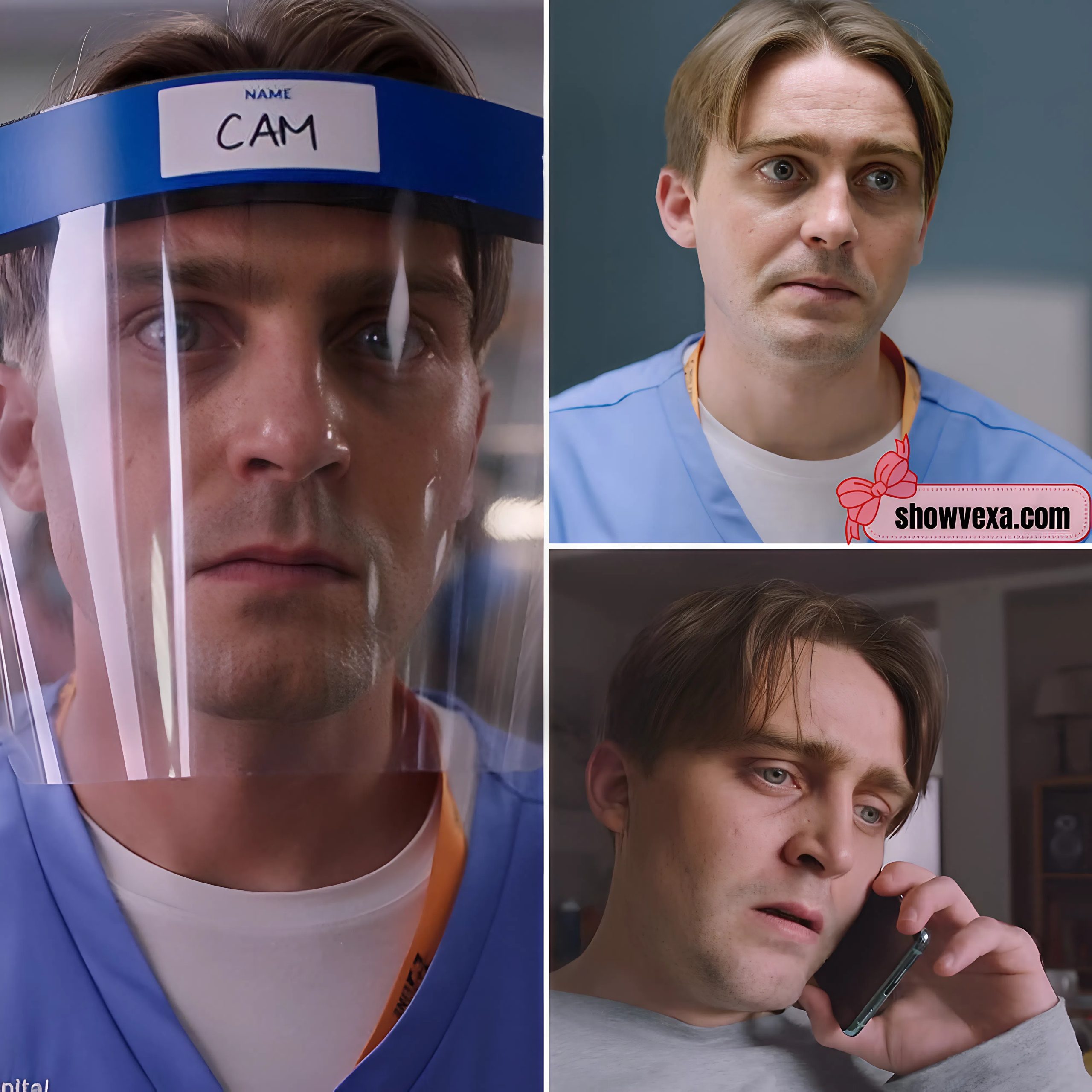
BBC Casualty: Cam Mickelthwaite Feels “Stuck” as ED Pressure Leaves Him Questioning His Role
In next week’s Casualty, the ongoing Lethal Legacy storyline continues to expose the emotional strain inside Holby City ED, with Cam Mickelthwaite facing a growing sense of frustration and helplessness as he struggles to find his place during an overwhelming shift.
With the military support now stood down, the Emergency Department remains far from stable, as patients continue to line the corridors and staff are forced to operate in a constant state of pressure and improvisation.
An ED Still Under Severe Strain
Although external assistance has been withdrawn, the situation inside Holby City Hospital shows little sign of easing. The ED remains overcrowded, with patients occupying corridors due to a lack of available beds and space in proper wards.
This ongoing pressure has forced staff into roles that are far from ideal, with many working outside their usual scope simply to keep the system functioning.
It is within this environment that Cam finds himself increasingly uncomfortable and emotionally disconnected.
Cam Left in a Holding Role
Cam has effectively been placed in charge of corridor patients — a role focused more on monitoring and managing flow than delivering active emergency intervention.
While clinically necessary, the position leaves him feeling underused and disconnected from the core medical action happening elsewhere in the department.
For someone motivated by making a direct impact, the situation quickly becomes frustrating. Instead of treating emergencies, he finds himself managing overflow, waiting, and observing rather than acting.
A Plea for Change
As his frustration builds, Cam approaches Siobhan McKenzie, asking to be reassigned to a more active clinical role.
His request is not driven by ego, but by a growing sense of uselessness. He feels unable to contribute in a meaningful way, despite being fully present in one of the most demanding hospital environments.
However, with staffing stretched and priorities focused on stabilising the ED, there is little flexibility in assigning roles.
Siobhan is unable to immediately change his position, leaving Cam with no option but to continue in his current capacity.
Emotional Strain Beneath the Surface
Although Cam’s struggle is practical on the surface, it carries a deeper emotional weight. Having recently returned to work after a traumatic experience, his confidence is still in recovery.
Being placed in a passive role during a major crisis intensifies feelings of self-doubt and frustration.
He is physically present in the heart of the action, but emotionally feels increasingly removed from it.
The Challenge of Making a Difference

Despite his frustrations, Cam’s storyline is not purely about limitation — it also explores the challenge of finding meaning in less visible roles.
The corridor patients he oversees are still vulnerable and in need of care, even if their treatment is less dramatic than emergency resuscitation cases.
The question becomes whether Cam can redefine what “making a difference” looks like in this environment.
A Shift That Tests Identity, Not Just Skill
Unlike other high-intensity storylines in Casualty, Cam’s arc is defined less by crisis and more by identity.
He is not being tested on technical ability, but on how he sees his own value within a system that is stretched beyond recognition.
This creates a quieter but equally significant emotional conflict, as he struggles to reconcile expectation with reality.
Conclusion: Finding Purpose in the Margins
As Casualty continues its Lethal Legacy arc, Cam Mickelthwaite’s storyline highlights a different side of emergency medicine — one where impact is not always measured in dramatic interventions, but in quieter forms of care.
In a hospital overwhelmed by crisis, even those working in less visible roles are still essential to keeping the system functioning.
And as Cam faces another corridor shift, one question remains at the heart of his journey: can he find purpose in a role he never expected to play — or will feeling “stuck” push him further away from the job he trained to do?