
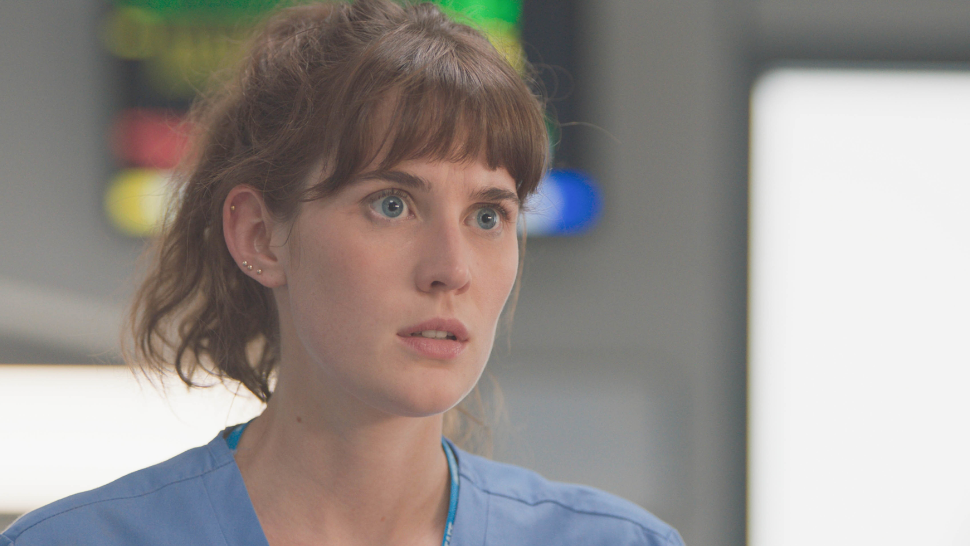
Casualty: Jodie’s Investigation Takes Dark Turn as Laura Rejects Medical Explanation in Heartbreaking ED Storyline
In the latest developments from BBC’s long-running medical drama Casualty, tensions rise in Holby City Hospital as Jodie’s ongoing investigation into a devastating neonatal case reaches an emotional breaking point. What begins as a clinical effort to uncover the truth quickly becomes a deeply personal battle involving grief, guilt, and conflicting beliefs about responsibility.
A Grieving Mother Returns to Holby ED
The episode opens with grieving mother Laura being admitted back into the Emergency Department following the tragic loss of her newborn son. Her return is immediately charged with emotion, as staff recognize that her physical recovery is overshadowed by unresolved trauma and overwhelming guilt. Laura’s mental state becomes a central focus, with the hospital environment amplifying her distress rather than offering comfort.
Jodie, already invested in the circumstances surrounding the baby’s death, quickly identifies a troubling pattern in Laura’s behaviour. It becomes clear that Laura has relapsed into alcohol use, a development that she believes is directly linked to her son’s premature birth and subsequent death. This revelation adds another layer of complexity to an already sensitive case, forcing the ED team to balance medical facts with emotional support.
Jodie and Rash Search for Answers
As Laura struggles with guilt and self-blame, Jodie and Rash work together to piece together what really happened. Rash Masum, drawing on his clinical expertise, supports Jodie’s growing suspicion that the situation may not be as straightforward as Laura fears. Together, they attempt to steer Laura away from internalising responsibility and instead consider an alternative explanation rooted in environmental factors.
Their attention turns to Wyvern Hill Estate, a location previously flagged in connection with toxic exposure concerns. Both Jodie and Rash begin to suspect that chemical contamination may have played a significant role in the complications surrounding Laura’s pregnancy and her baby’s premature birth. This theory introduces a broader public health angle to the storyline, shifting the narrative from individual blame to systemic failure.
A Theory of Environmental Harm
Jodie presents the possibility that exposure to harmful substances from Wyvern Hill Estate may have contributed to the tragic outcome. The suggestion reframes the case entirely, challenging Laura’s belief that her alcohol relapse caused the death of her child. However, the emotional weight of grief proves far stronger than clinical reasoning.

Laura rejects the explanation outright. In her mind, responsibility remains personal, not environmental. The idea that external contamination played a role does little to ease her guilt, and instead creates further emotional distance between her and the medical staff trying to help her. This moment becomes a powerful depiction of how grief can override even the most carefully constructed medical arguments.
Emotional Clash in the ED
The disagreement between Laura and the medical team escalates into one of the episode’s most emotionally charged sequences. Jodie, determined to provide clarity and prevent Laura from spiralling further into self-blame, finds herself facing resistance at every turn. Rash attempts to mediate, offering reassurance grounded in evidence, but the emotional reality of Laura’s loss proves difficult to penetrate.
The storyline highlights the often unseen emotional labour carried out by emergency department staff, particularly when dealing with bereaved families. Both Jodie and Rash are shown not only as clinicians but also as emotional anchors, trying to support a patient whose grief has become intertwined with guilt and denial.
The Power of Grief and Misdirection
Laura’s refusal to accept the environmental explanation underscores one of the episode’s key themes: the human need to assign blame in the face of tragedy. Her belief that her relapse caused her baby’s death reflects a deeply personal coping mechanism, even if it contradicts medical reasoning.
For Jodie, the challenge is not only to uncover the truth but to navigate the emotional barriers that prevent that truth from being accepted. The investigation becomes less about diagnosis and more about communication, empathy, and timing. Rash’s involvement reinforces the importance of multidisciplinary support in cases where medical facts alone are not enough to heal emotional wounds.
Wyvern Hill Estate and the Wider Mystery
The mention of Wyvern Hill Estate continues to build a broader narrative thread within Casualty, hinting at potential environmental wrongdoing that could have far-reaching consequences beyond this single case. The storyline suggests that multiple patients may have been affected, positioning the investigation as part of a larger unfolding mystery within Holby’s catchment area.
While the medical team focuses on Laura’s immediate care, the implications of toxic exposure raise questions about accountability, public safety, and institutional oversight. This expands the scope of the storyline beyond the hospital walls, reinforcing the show’s ongoing interest in socially relevant medical issues.

A Story Rooted in Emotion and Uncertainty
As the episode concludes, Laura remains unconvinced by Jodie and Rash’s explanation, leaving the investigation unresolved and emotionally fragile. The lack of closure reflects the realism often portrayed in Casualty, where answers are not always immediate, and emotional healing rarely follows a straight path.
For Jodie, the case represents both a professional challenge and a personal test of resilience. For Laura, it is the beginning of a longer and more painful journey toward understanding her grief. And for Rash, it reinforces the ongoing burden carried by those working in emergency medicine, where truth and comfort do not always align.
As Holby ED continues to navigate complex cases like this, viewers are left with lingering questions about responsibility, truth, and the fragile intersection between medicine and emotion.