
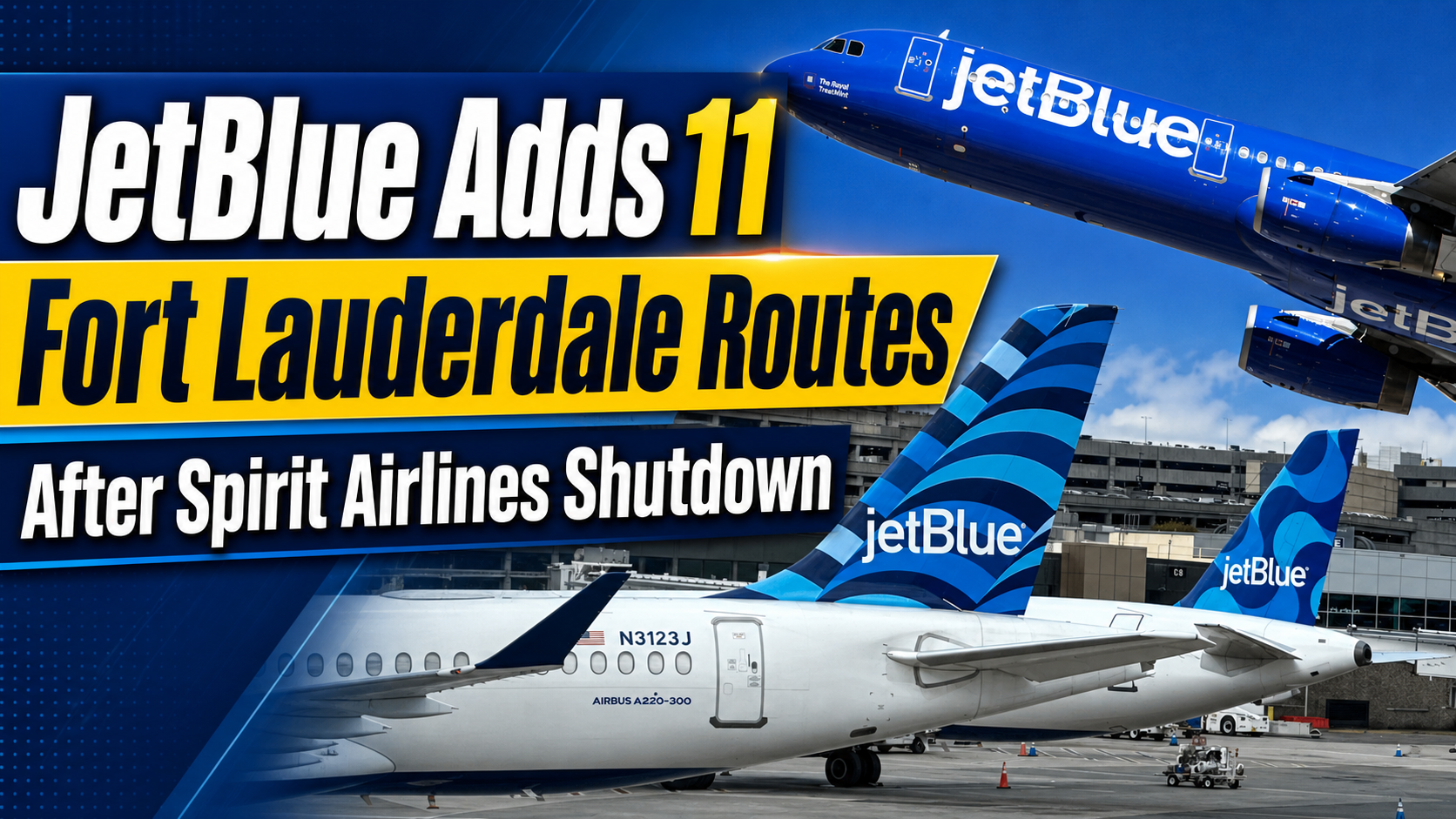
JetBlue Adds 11 Fort Lauderdale Routes After Spirit Airlines Shutdown
JetBlue Airways is moving quickly to expand in South Florida after Spirit Airlines abruptly ceased operations, announcing 11 new routes from Fort Lauderdale-Hollywood International Airport that directly replace markets previously served by the ultra-low-cost carrier.
According to the source material, JetBlue’s new Fort Lauderdale routes are scheduled to begin in phases from July 9, with additional services launching later in the year. The expansion is expected to make Fort Lauderdale JetBlue’s largest-ever operation at the airport, with nearly 130 daily departures projected for the summer.
The move comes after Spirit Airlines, a major low-cost U.S. carrier known for budget fares and à la carte pricing, said it had begun winding down operations after 34 years. The shutdown has left passengers seeking refunds or replacement flights and has affected roughly 17,000 employees, according to the source material.
JetBlue Steps Into Spirit’s South Florida Market
Fort Lauderdale-Hollywood International Airport is one of the main airports serving South Florida, a region that includes Miami, Fort Lauderdale and nearby coastal communities. For years, Spirit used Fort Lauderdale as a major base for domestic and international leisure travel.
JetBlue’s expansion is aimed at maintaining service in several of those markets. According to the source material, all 11 routes were previously served by Spirit before its closure.
JetBlue CEO Joanna Geraghty said in a statement cited by the source that South Florida remains an important market for the airline and that JetBlue wants to maintain connectivity while keeping fares competitive. She also acknowledged the disruption facing Spirit employees and customers.
New JetBlue Routes From Fort Lauderdale
The first group of new routes is scheduled to begin July 9. According to the source material, JetBlue plans to fly from Fort Lauderdale to:
- Baltimore-Washington International Airport, three times daily
- Charlotte Douglas International Airport, three times daily
- Chicago O’Hare International Airport, twice daily
- Detroit Metropolitan Wayne County Airport, twice daily
- Houston Bush Intercontinental Airport, three times daily
- Nashville International Airport, three times daily
- Mercedita International Airport in Ponce, Puerto Rico, daily
Additional routes are scheduled for later in the year. JetBlue plans daily service to Barranquilla, Colombia, from October 1 and Cali, Colombia, from October 15. Daily flights to Columbus, Ohio, and Indianapolis, Indiana, are expected to begin November 2.
Six of the announced destinations — Barranquilla, Baltimore, Cali, Charlotte, Columbus and Indianapolis — were not previously served by JetBlue, according to the source material.
Why the Shutdown Matters for Travelers
Spirit’s exit could have a significant effect on budget-conscious travelers, especially those flying in and out of Florida, Las Vegas and other leisure-heavy markets. The source material, citing aviation analytics firm Cirium, said Spirit’s collapse removed nearly 2 percent of all U.S. domestic airline seats overnight.
That loss of capacity may matter most on routes where Spirit provided lower-cost competition. While JetBlue’s expansion may help preserve some connectivity, the source material said fares on former Spirit routes could rise if competition weakens. That should be treated as a market concern rather than a confirmed outcome.
The source also said shares of JetBlue Airways and Frontier Airlines rose after a Wall Street Journal report said Spirit was preparing to cease operations. According to that report, Spirit had been negotiating a possible $500 million federal lifeline, but the proposed rescue did not come together.
Refunds and Rescue Fares
Spirit said it had nearly completed refunds for passengers and had returned most crew members to their home bases, according to the source material citing Reuters.
Most customers who booked with credit or debit cards had reportedly been refunded by Saturday evening, though a small share of refunds was still being processed. The airline also said a final group of about 1,500 crew members was rebased over the weekend.
For stranded passengers, several U.S. airlines have offered temporary rescue fares. The source material said United, Delta, JetBlue and Southwest offered $200 one-way flights for travelers who could show Spirit confirmation numbers and proof of purchase.
Spirit said customers who booked directly with the airline could expect refunds. Those who purchased tickets through third-party vendors were told to seek refunds from those vendors. The source material also said Spirit would not assist passengers in booking replacement travel on other airlines.
Workforce Impact and Passenger Disruption
The end of Spirit’s operations has created immediate uncertainty for employees and travelers. According to the source material, roughly 17,000 workers were affected.
The report included accounts from passengers who arrived at airports unaware their flights had been canceled, as well as comments from a former Spirit flight attendant who described the emotional impact of the closure and criticized management communication in the final days. These accounts should be understood as individual experiences reported by the Associated Press and included in the source material.
Bailout Talks and Political Reaction
The source material said President Donald Trump had floated the idea of a federal bailout, while U.S. Transportation Secretary Sean Duffy described a government proposal as a final offer. The deal was not reached.
The report also described competing political claims about responsibility for Spirit’s financial problems. Trump administration officials pointed to the Biden administration’s opposition to a previous Spirit-JetBlue merger, while a policy analyst at the Cato Institute argued that the Trump administration also bore responsibility because of policy decisions that allegedly affected fuel costs.
Because these claims are political and contested, they should be presented only as attributed viewpoints, not as settled conclusions.
A Turning Point for Low-Cost Air Travel
Spirit’s shutdown marks a major change in the U.S. low-cost airline market. For international readers, the significance is not only that one airline has stopped flying, but that a major source of budget capacity has disappeared from important leisure routes.
JetBlue’s new Fort Lauderdale routes may help reduce the immediate disruption for some travelers, particularly in South Florida. But the longer-term effects on fares, route competition and airline employment will depend on how quickly other carriers move into Spirit’s former markets.
For now, the clearest development is that JetBlue is using Fort Lauderdale as the center of its response, turning Spirit’s sudden absence into one of the most significant route expansions in its South Florida network.