
Marshals Episode 8 Finally Delivers What The Yellowstone Spin-Off Has Been Missing
After weeks of mixed reactions from fans of the Yellowstone universe, Marshals has finally delivered the turning point many viewers have been waiting for. Episode 8, titled “Blowback,” marks a dramatic shift in tone for the spin-off, moving away from its procedural “case-of-the-week” structure and plunging directly into the kind of high-stakes, morally charged conflict that defined the original Dutton saga.
For much of its early run, Marshals has been criticized for feeling too restrained compared to its predecessor. While Yellowstone, 1883, and 1923 thrived on ruthless antagonists, escalating power struggles, and emotionally devastating consequences, Marshals initially leaned into a safer, more network-style format. That approach, however, is completely abandoned in this episode as the series unleashes its most dangerous antagonist yet.
Randall Clegg Steps Out Of The Shadows
At the center of this tonal shift is Randall Clegg, portrayed by Michael Cudlitz, who finally emerges as a fully realized and deeply menacing force. Until now, Clegg has operated in the background—more of a looming threat than an active participant in the chaos surrounding Kayce Dutton and his team.
In “Blowback,” that changes dramatically.
Following a series of escalating tensions and unfinished confrontations, Clegg decides to abandon any remaining restraint. What begins as calculated intimidation quickly transforms into an all-out campaign of revenge. The episode reveals a man no longer interested in negotiation, leverage, or strategic positioning. Instead, Clegg commits fully to destruction—both personal and professional—for anyone standing in his way.
The transformation is not subtle. Clegg’s shift into full antagonist mode gives the episode its driving force, injecting the kind of unpredictability that had been missing from earlier installments.
Andrea Cruz Becomes The Catalyst For Chaos
The emotional core of the episode revolves around Andrea Cruz, played by Ash Santos, whose abduction becomes the turning point in Clegg’s vendetta against Kayce Dutton.
Andrea’s kidnapping is not random—it is calculated, strategic, and deeply personal. By targeting her, Clegg directly attacks Kayce’s emotional stability and leadership under pressure. The move immediately raises the stakes for the entire Marshals unit, forcing them into a situation where protocol and procedure are no longer enough.
For Kayce, the abduction reignites a conflict that has defined much of his journey throughout the Yellowstone universe: the struggle between controlled authority and raw instinct. As a former soldier and rancher now operating within federal law enforcement, Kayce is forced to confront whether institutional boundaries can survive when someone he cares about is used as leverage.
Luke Grimes delivers a performance rooted in tension and restraint, portraying a man trying to remain operational while clearly unraveling beneath the surface.
Kayce Dutton Under Extreme Pressure
Throughout “Blowback,” Kayce Dutton is pushed further than he has been at any point in the spin-off so far. The structured environment of the Marshals service begins to fracture as personal stakes override procedural discipline.
The episode explores Kayce’s dual identity more aggressively than previous installments. On one hand, he is expected to act within the law, follow chain of command, and maintain operational integrity. On the other, he is a Dutton—a man shaped by violence, survival, and deeply personal loyalty.
This internal conflict becomes the emotional engine of the episode. Every decision Kayce makes is filtered through the fear that adherence to rules may cost Andrea her life. At the same time, abandoning those rules risks escalating the situation beyond control.
The result is a layered portrayal of a character caught between two incompatible worlds, neither of which offers a clean resolution.
A Return To The Brutality Fans Expected
One of the most significant impacts of Episode 8 is its return to the raw brutality that defined earlier Yellowstone storytelling. The episode does not rely on courtroom tension, procedural investigation, or slow-building mystery. Instead, it embraces direct confrontation, emotional volatility, and immediate consequences.
Clegg’s actions escalate rapidly, revealing a coordinated network of associates willing to execute violent orders without hesitation. This expands the threat beyond a single antagonist and positions the conflict as a wider criminal operation rather than an isolated vendetta.
The shift in scale is crucial. It transforms what could have remained a personal dispute into a broader crisis, forcing the Marshals team to operate under conditions closer to open warfare than structured enforcement.
Team Dynamics Begin To Fracture
As the situation intensifies, the Marshals unit itself begins to show signs of strain. Trust, already fragile due to differing backgrounds and operational philosophies, is tested under extreme pressure.
Some team members push for immediate tactical intervention, while others advocate for restraint and intelligence-led action. These disagreements highlight the underlying tension within the unit: a group brought together by necessity rather than cohesion.
Kayce, positioned at the center of this conflict, becomes both leader and emotional liability. His personal involvement in Andrea’s kidnapping raises questions about objectivity, while also reinforcing his authority through experience and instinct.
This duality adds complexity to the team dynamic, suggesting that future episodes may explore not only external threats, but internal fractures as well.
A Turning Point For The Spin-Off
Episode 8 is widely positioned as a turning point for Marshals as a series. By introducing a fully developed antagonist, raising emotional stakes, and shifting away from procedural predictability, the show aligns more closely with the dramatic intensity expected from the Yellowstone franchise.
Critically, the episode addresses one of the most consistent criticisms of the spin-off: a lack of sustained narrative danger. With Clegg now fully operational as a central threat, the series gains a long-term antagonist capable of driving multiple episodes and potentially shaping the season’s overall arc.
The kidnapping of Andrea Cruz also ensures that the consequences of this conflict will extend beyond a single episode, creating a narrative thread that demands resolution rather than reset.
Michael Cudlitz Delivers A Defining Performance
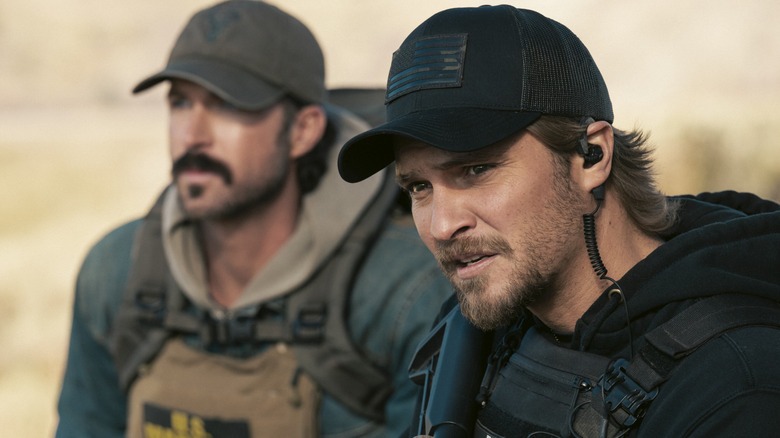
Michael Cudlitz’s portrayal of Randall Clegg stands out as one of the episode’s most compelling elements. His performance avoids theatrical villainy in favor of controlled intensity, presenting a character whose calm demeanor only heightens the sense of unpredictability.
Rather than relying on exaggerated threats, Clegg is portrayed as methodical, patient, and strategically focused—qualities that make him significantly more dangerous within the Marshals universe.
This grounded approach enhances the realism of the conflict and positions Clegg as a long-term adversary rather than a temporary obstacle.
Conclusion: The Beginning Of A Darker Chapter
With “Blowback,” Marshals finally embraces the narrative identity fans of the Yellowstone universe were expecting: morally complex characters, escalating violence, and emotionally driven conflict where no outcome feels guaranteed.
The episode not only elevates Randall Clegg into a major antagonist but also forces Kayce Dutton into his most vulnerable and unpredictable position yet within the spin-off.
As the consequences of Andrea Cruz’s kidnapping continue to unfold, one thing becomes clear: Marshals is no longer operating within the safety of procedural storytelling. It has entered a more dangerous, emotionally charged phase—one where every decision carries irreversible consequences, and where the legacy of the Dutton family continues to cast a long, violent shadow.