
Sheila’s Deadly Illness Plan: Taylor leaves town after being dumped The Bold and the Beautiful
The latest developments in The Bold and the Beautiful deliver a chilling exploration of psychological manipulation, emotional vulnerability, and the dangerous consequences of blurred moral lines. At the center of the storm is Sheila Carter, once again proving that her most powerful weapon is not violence—but control.
In a storyline that steadily escalates from subtle deception to full-scale emotional warfare, Sheila executes one of her most calculated schemes yet: a fabricated—or at the very least, deeply manipulated—terminal illness designed to reclaim Deacon Sharpe and eliminate Taylor Hayes from the equation.
And this time, the fallout is devastating.
Sheila Carter Reinvents Herself—As a Victim
For years, Sheila Carter has been synonymous with chaos, unpredictability, and outright danger. But in a shocking shift, she abandons her usual tactics of aggression and instead adopts a far more insidious persona—fragility.
Her return to Deacon’s life is not marked by confrontation or apology. Instead, it is defined by subtle behavioral changes. A lingering cough. Moments of unexplained fatigue. Carefully timed collapses that seem almost incidental, yet impossible to ignore.
At first, Deacon dismisses these signs as stress or exhaustion. But Sheila understands human psychology better than most. She does not tell him she is sick—she allows him to believe it.
And belief, once planted, begins to grow.
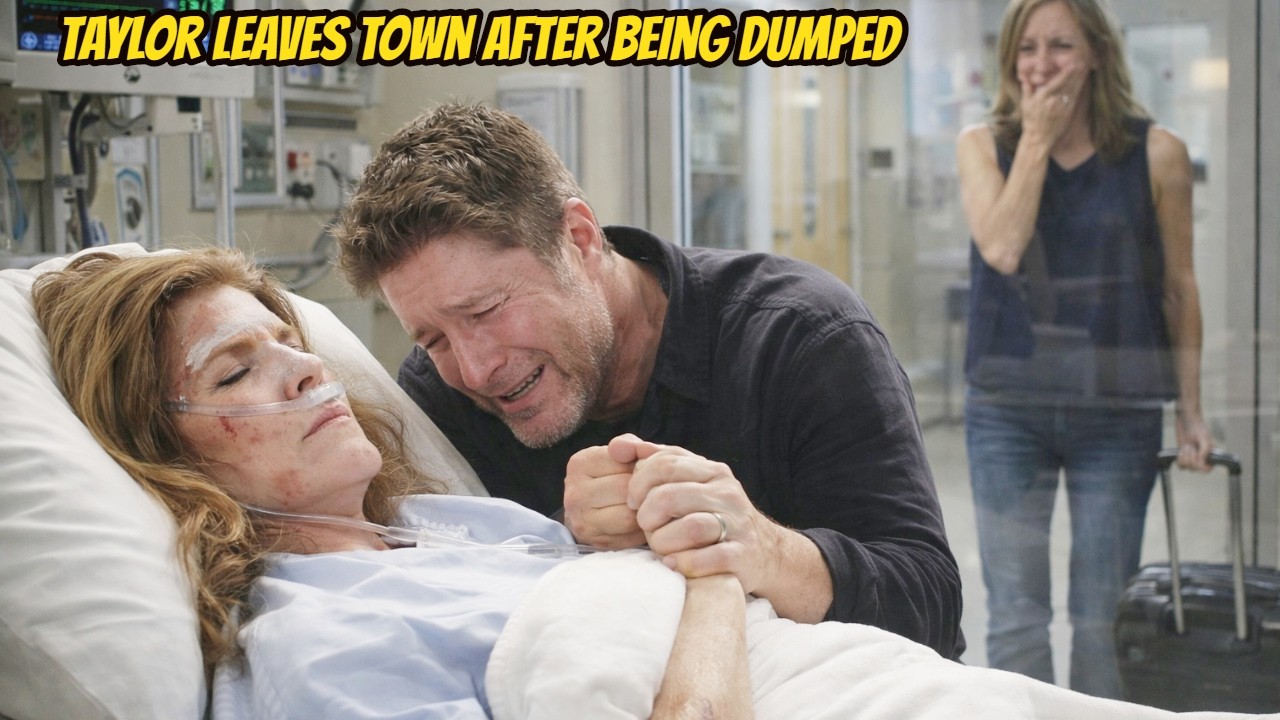
The turning point comes with a hospital visit, meticulously orchestrated to deliver maximum emotional impact. Doctors speak in vague but ominous terms: an advanced condition, uncertain prognosis, limited time. The ambiguity is deliberate. It invites fear, and fear invites attachment.
Sheila’s reaction is equally calculated. She does not break down. She does not beg. Instead, she accepts her fate with quiet dignity—and makes a single request.
Time with Deacon.
Deacon Sharpe Falls Into Emotional Captivity
For Deacon, the situation presents itself as a moral crossroads. Faced with the possibility that Sheila may be dying, he begins to reframe their relationship—not as a toxic entanglement, but as an opportunity for redemption.
He convinces himself that staying by her side is not betrayal—it is compassion.
Gradually, his priorities begin to shift. Missed dinners with Taylor. Shortened conversations. Emotional distance that grows harder to explain.
What he does not realize is that he is being drawn into a carefully constructed emotional loop.
Sheila never demands too much. She never pushes too hard. Instead, she operates in cycles—periods of calm followed by sudden, alarming deterioration. Each “episode” reinforces Deacon’s sense of responsibility. Each recovery convinces him that his presence matters.
Without realizing it, Deacon reorganizes his life around her condition.
And in doing so, he becomes trapped.
Taylor Hayes Begins to See the Truth
Unlike Deacon, Taylor Hayes is not easily swayed by emotional narratives—especially when they appear too perfect.
As a trained psychiatrist, she quickly senses that something about Sheila’s illness does not align with typical medical or psychological patterns. The symptoms are inconsistent. The timing is suspicious. The progression lacks clinical logic.
But Taylor does not confront Sheila immediately. She understands that direct accusations would only backfire, pushing Deacon further into Sheila’s defense.
Instead, she observes.
Quietly. Methodically.
She tracks patterns, reviews medical reports, and consults specialists. What she uncovers is not definitive proof of deception—but something arguably more dangerous: inconsistency.
And inconsistency breeds doubt.
A Dangerous Game of Control Escalates
As Taylor’s suspicions deepen, Sheila adapts.
This is no longer passive manipulation—it is active maintenance of a narrative. Every time Taylor edges closer to the truth, Sheila’s condition appears to worsen. New symptoms emerge. Crises become more frequent.
The implication is clear: Sheila is willing to go to extreme lengths—even self-inflicted harm—to preserve the illusion.
This realization transforms the situation from manipulation into obsession.
And obsession, as Taylor knows, does not retreat under pressure—it escalates.
Meanwhile, Deacon becomes increasingly isolated—not physically, but psychologically. His world narrows to a single focus: Sheila’s survival. Any challenge to that reality, including Taylor’s concerns, begins to feel like a threat rather than a warning.
Taylor’s attempts at gentle intervention are reframed as cruelty. Her logic is overshadowed by Sheila’s vulnerability.
The balance of power shifts.
The Breaking Point: Taylor Loses Deacon
The emotional tipping point comes during a staged medical crisis—Sheila’s most dramatic performance yet.
Faced with what appears to be a life-threatening episode, Deacon reacts instinctively. He chooses Sheila. Completely. Without hesitation.
In that moment, Taylor realizes the truth she has been trying to avoid: she has already lost him.
Not because Sheila proved her case—but because she controlled the narrative long enough for Deacon to accept it as reality.
And once belief replaces doubt, logic becomes irrelevant.
Taylor’s Final Decision: Walk Away
Despite gathering mounting evidence of inconsistencies, Taylor understands that exposing Sheila now would not restore balance—it would cause collapse.
Deacon is too emotionally invested. Too deeply embedded in the role Sheila has created for him.
Breaking that illusion abruptly could shatter him.
So Taylor makes a painful but decisive choice.
She walks away.
Not in defeat—but in recognition.
She refuses to remain in a dynamic where truth is distorted, where manipulation is rewarded, and where love is overshadowed by obligation.
Her departure marks a turning point—not just in her relationship with Deacon, but in the broader battle against Sheila’s influence.
Sheila Wins—For Now
With Taylor gone, Sheila achieves her immediate objective.
Deacon remains by her side, fully committed to the role she has designed for him. The illusion holds. The narrative continues.
But beneath the surface, cracks are forming.
Because Taylor did not leave empty-handed.
She left with evidence.
And more importantly, with clarity.
A War of Realities Has Begun
This storyline pushes The Bold and the Beautiful into darker, more psychologically complex territory. It is no longer a simple battle of right versus wrong—it is a conflict over perception, belief, and control.
Sheila is not just manipulating events—she is redefining reality.
Taylor, meanwhile, is preparing for something far more dangerous than confrontation: exposure.
And Deacon remains at the center of it all—caught between two competing truths, unaware that his entire emotional framework has been carefully engineered.
Final Thoughts
“Sheila’s Deadly Illness Plan” is a masterclass in slow-burn tension and character-driven drama. It explores how easily perception can be shaped, how quickly compassion can be weaponized, and how dangerous it becomes when truth is no longer the dominant force.
As Taylor exits the battlefield—for now—the question is no longer whether Sheila is lying.
The question is:
How long can her version of reality survive before it collapses under its own weight?
Because in a world built on illusion, the truth does not disappear.
It waits.