
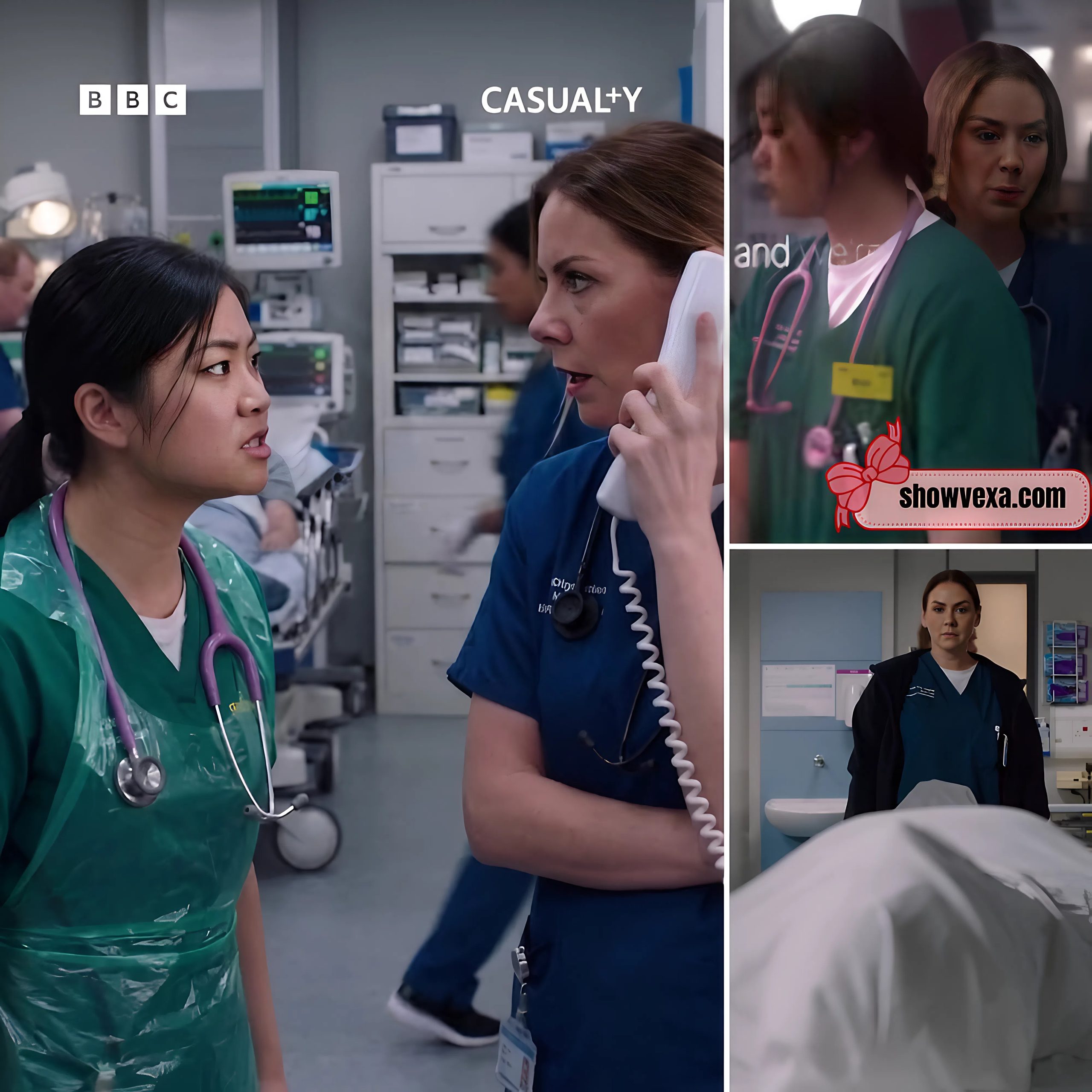
Stevie Nash’s Decision Comes Back to Haunt Her: Tamponade Gamble Ends in Shocking ED Fallout in Casualty
The fallout from the controversial tamponade intervention continues to escalate inside the Emergency Department of Casualty, as tensions explode into a full-scale professional investigation that could permanently alter the careers of both Dr Stevie Nash and Kim Chang.
What began as a split-second life-or-death decision has now become a formal internal case review, with hospital leadership demanding answers over the handling of a peri-arrest cardiac tamponade case that divided the resus team and left one patient in a fragile post-crisis state.
At the centre of the storm is Stevie Nash, played by Elinor Lawless, who is now being called to justify every second of her decision-making under extreme pressure. But the situation takes an unexpected turn when junior clinician Kim Chang, portrayed by Jasmine Bayes, is suddenly placed under formal scrutiny for her role in the escalating conflict.
According to internal whispers from the ED, hospital management is not only questioning the clinical choice itself—but also the breakdown in team communication that led to such a polarised and dangerous moment. In particular, Kim’s repeated refusal to support the procedure is now being examined through a disciplinary lens, with senior staff debating whether her resistance was justified caution or disruptive hesitation in a critical emergency.
Inside Casualty, the atmosphere is described as “tense, silent, and fractured.” Staff members who witnessed the incident are being called in for statements, and what was once a fast-moving emergency has now turned into a slow-burning professional crisis.
Stevie, however, is not escaping scrutiny either. During the hearing, she is forced to relive the moment she issued the now-infamous command: “Back me, or leave!” That phrase has become a focal point of the investigation, with management questioning whether her leadership style crossed the line between decisive action and dangerous authoritarian pressure.
Sources suggest that Stevie’s defence is emotionally charged but clinically grounded. She argues that the patient was in peri-arrest, that imaging delays could have cost a life, and that her decision—though risky—was made in accordance with emergency trauma training principles. But even as she speaks, it becomes clear that the emotional toll of the case is beginning to weigh heavily on her confidence.
Meanwhile, Kim Chang’s situation grows increasingly precarious. Initially seen as the voice of protocol in a chaotic moment, she now finds herself caught in a complex disciplinary grey zone. Senior consultants are divided over whether her refusal to fully support Stevie’s intervention protected the patient—or endangered them by delaying action in a time-critical scenario.
The hearing becomes less about right and wrong, and more about interpretation under pressure. In the world of Casualty, where seconds define survival, the line between caution and hesitation is razor-thin.
Outside the hearing room, the ED itself is struggling to function normally. Nurses and junior staff are visibly unsettled, unsure which leadership style to trust. Some quietly admire Stevie’s willingness to act decisively under extreme conditions, while others sympathise with Kim’s insistence on safety checks and diagnostic confirmation.
This divide is creating a subtle but dangerous ripple effect through the department. Communication is becoming strained, decisions are being second-guessed, and morale is slipping at a time when the ED is already under pressure from ongoing scrutiny tied to the “Learning Curve” arc.
Faith Dean, played by Kirsty Mitchell, attempts to stabilise the team dynamic, stepping into an unofficial mediator role. She urges staff to separate personal emotion from clinical judgment, but even her experience cannot fully contain the growing tension between factions forming around Stevie and Kim.
Rida Amaan, portrayed by Sarah Seggari, also finds herself emotionally conflicted. Having witnessed the original resus chaos firsthand, she understands both sides of the argument. Her internal struggle reflects the broader uncertainty gripping the department: when everything happens too fast, who can truly be held accountable?
As the investigation progresses, a key revelation shifts the tone of the entire case. New clinical review data suggests the patient’s presentation may have been more ambiguous than initially assumed, meaning both Stevie’s urgency and Kim’s caution may have been simultaneously valid—and dangerously incomplete.
This revelation sends shockwaves through the hearing room. Suddenly, the narrative is no longer about one right decision, but about systemic failure under pressure. Equipment delays, staffing shortages, and communication breakdowns all come under fire, painting a picture of an ED stretched beyond safe operational limits.
Stevie reacts visibly to this shift, her earlier defensiveness giving way to something more reflective. For the first time, she acknowledges that her certainty in the moment may have masked deeper uncertainty beneath the surface. Kim, meanwhile, is forced to reconsider whether her resistance stemmed purely from protocol—or fear of making a fatal mistake.
The emotional climax of the storyline comes when both clinicians are asked the same question: “Would you make the same decision again?” The silence that follows is reportedly one of the most powerful moments in recent Casualty history, with neither able to answer immediately.
Behind the scenes, this arc is being described as a defining chapter for both characters. Stevie Nash is being pushed into a more introspective phase, where confidence must now coexist with doubt. Kim Chang, meanwhile, is evolving from a rule-focused junior clinician into a more complex figure grappling with the reality that medicine is rarely black and white.
As the hearing concludes, no clear winner emerges. Instead, the ED is left with something far more unsettling: ambiguity. No suspension is immediately confirmed, but both clinicians are placed under formal review, with their future roles hanging in the balance.
The final moments show Stevie and Kim passing each other in silence outside the hospital corridor. No confrontation. No resolution. Just two professionals carrying the weight of a moment that cannot be undone.
And inside Casualty, one truth becomes impossible to ignore:
In emergency medicine, the hardest cases are not the ones you lose—but the ones that refuse to give you a clear answer.