
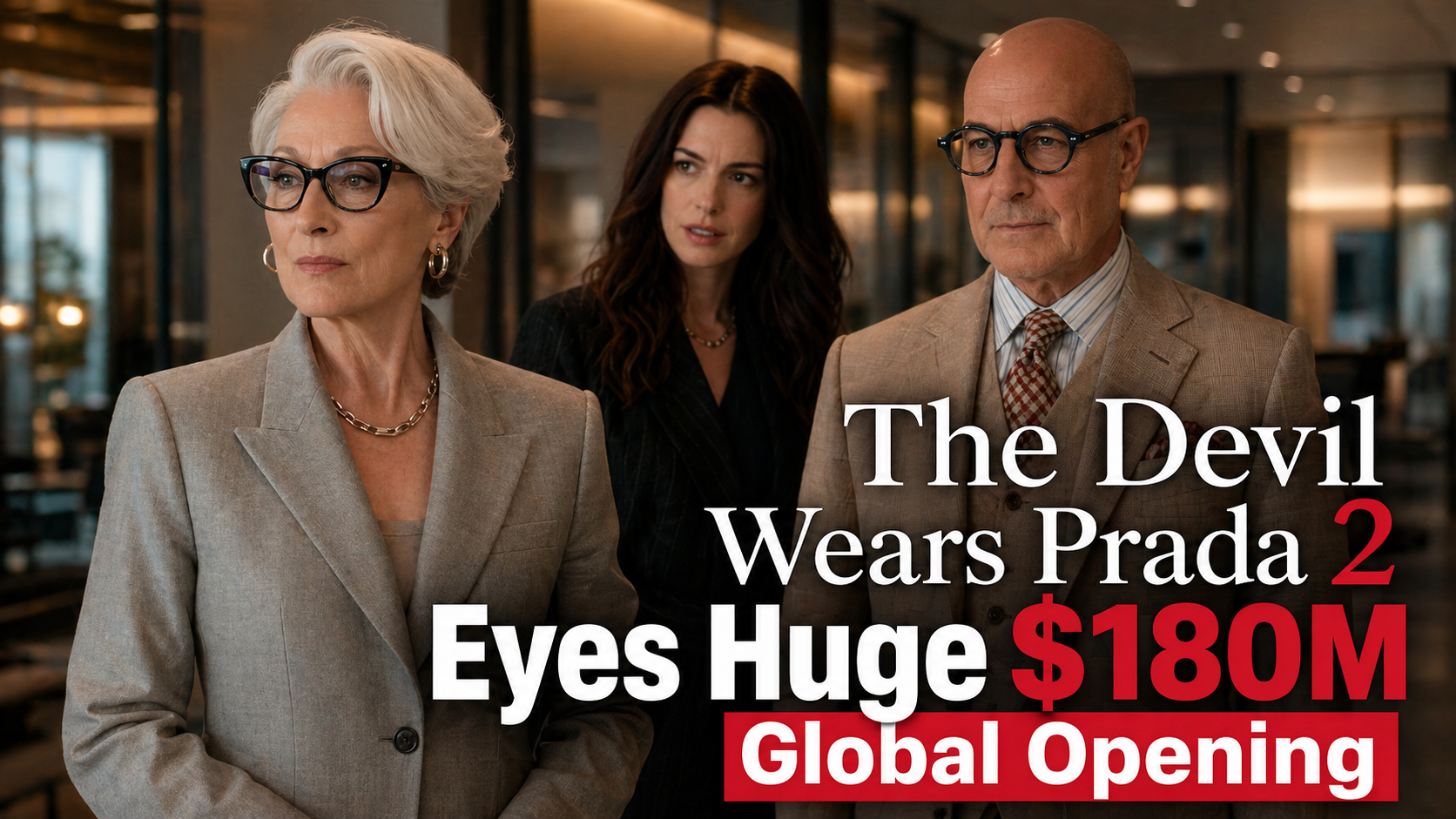
The Devil Wears Prada 2 Eyes Huge $180M Global Opening
The summer box office may be about to begin not with capes, explosions or multiverse chaos, but with stilettos, side-eye and the return of Miranda Priestly.
Nearly 20 years after The Devil Wears Prada became one of the defining pop-culture comedies of the 2000s, The Devil Wears Prada 2 is stepping back into theaters with unusually high expectations. Early tracking points to a powerful global launch near $180 million, positioning the sequel as one of the first major commercial tests of the summer movie season. StarBiz reported projections of $65 million to $70 million domestically, with international markets potentially contributing another $110 million, while Business Today cited a wider North American range of $73 million to $80 million and a worldwide total close to $180 million.
That kind of launch would be striking for any studio comedy-drama. For a fashion-world sequel built on nostalgia, star power and a beloved original rather than superheroes or action spectacle, it could be even more significant.
A Sequel Arrives With Blockbuster-Sized Expectations
The Devil Wears Prada 2 is set to debut exclusively in theaters on May 1, 2026. The official 20th Century Studios page lists the film as a PG-13 comedy-drama and confirms the return of Meryl Streep, Anne Hathaway, Emily Blunt and Stanley Tucci as Miranda, Andy, Emily and Nigel. Director David Frankel and writer Aline Brosh McKenna, both central to the original film’s screen identity, are also back for the sequel.
The film’s commercial promise appears to be built on several overlapping factors: long-term affection for the 2006 original, a returning principal cast, strong interest from women moviegoers, and a marketing campaign that has leaned into the property’s fashion-world appeal. Business Today reported that advance sales had reached around $20 million in the U.S. and Canada across more than 4,000 cinemas, a strong signal for a title whose appeal stretches beyond traditional opening-weekend fanboy audiences.
The original The Devil Wears Prada became more than a box office success. It turned Miranda Priestly into one of modern cinema’s most quoted bosses, helped cement Anne Hathaway’s transition into adult star vehicles, and gave fashion media a glossy, cuttingly funny big-screen mythology. The first film earned more than $326 million globally, a benchmark that still gives the sequel a substantial commercial shadow to chase.
Miranda, Andy, Emily and Nigel Return to a Changed Media World
The sequel’s central draw is the reunion. Streep returns as Miranda Priestly, Hathaway as Andy Sachs, Blunt as Emily Charlton and Tucci as Nigel Kipling. According to 20th Century Studios, the new film returns to the streets of New York and the offices of Runway magazine almost two decades after the original characters became cultural shorthand for ambition, taste, pressure and reinvention.
The cast also expands with Kenneth Branagh, Simone Ashley, Justin Theroux, Lucy Liu, Patrick Brammall, Caleb Hearon, Helen J. Shen, Pauline Chalamet, B.J. Novak and Conrad Ricamora, while Tracie Thoms and Tibor Feldman reprise their roles from the first film.
That ensemble points to a sequel trying to do more than simply replay old favorites. The most interesting challenge for The Devil Wears Prada 2 is whether it can make Runway feel relevant in a media landscape that has changed dramatically since 2006. The first film arrived when glossy magazines still held enormous cultural authority. The sequel lands in a world shaped by digital publishing, social media influence, collapsing print prestige and the constant churn of online image-making.
That tension may be one reason the film is attracting attention beyond nostalgia. A sequel about Runway in 2026 is not just a return to a famous fictional office; it is a chance to revisit what power, taste and ambition mean when the old gatekeepers no longer control the whole conversation.
Why This Comeback Feels Bigger Than Nostalgia
Legacy sequels often sell comfort. The Devil Wears Prada 2 is selling something slightly sharper: the fantasy of returning to a world audiences know, while watching that world struggle to survive modern pressures.
That gives the film a timely hook. Andy Sachs, once the outsider learning how brutal and seductive the fashion-media machine could be, now returns to a world where the machine itself has changed. Miranda Priestly, once seemingly untouchable, exists in an industry where institutions have less security and influence is more fragmented. Emily, Nigel and the new characters add to the sense that Runway is no longer just a magazine setting; it is a symbol of an entire cultural ecosystem trying to adapt.
The marketing has also helped broaden the film into a lifestyle moment. Business Today noted promotional partnerships tied to fashion and beauty spaces, along with soundtrack attention around “Runway,” a Lady Gaga and Doechii track associated with the film’s campaign.
That matters because The Devil Wears Prada has always lived partly outside the movie itself. Its afterlife has been powered by memes, fashion references, workplace discourse, red-carpet nostalgia and endless quoting of Miranda’s most withering lines. The sequel is not simply asking audiences to remember a plot. It is asking them to return to a mood.
Early Buzz Suggests a Stylish but Closely Watched Return
Early reactions suggest the sequel is landing with a mix of affection, surprise and scrutiny. People reported that first responses praised the film’s humor, callbacks and emotional notes, with several viewers highlighting the returning cast’s chemistry. The same roundup also noted more reserved reactions from critics who felt the sequel did not fully match the original’s emotional resonance or narrative strength.
That balance may actually help the film. The first Devil Wears Prada was never just about plot mechanics; it was about performance, tone, pace and the pleasure of watching high-status characters weaponize style. If the sequel can deliver enough of that energy while giving audiences a reason to care about the characters now, it may not need universal critical rapture to become a box office event.
The opening weekend will still be an important measure. A near-$180 million worldwide start would prove that this brand has remained powerful across generations and markets. It would also offer another reminder that theatrical audiences are not only showing up for action franchises. They will turn out for star-driven, culturally recognizable stories when the packaging feels like an event.
Final: Runway Is Back in the Spotlight
For Disney and 20th Century Studios, The Devil Wears Prada 2 is more than a sequel. It is a test of how far nostalgia can travel when paired with a glamorous world, a returning cast and a story that reflects how much the media business has changed.
For audiences, the appeal is more emotional: Miranda, Andy, Emily and Nigel are back, and so is a version of moviegoing that feels glossy, quotable and communal.
The first film made ambition look terrifying and irresistible. Two decades later, The Devil Wears Prada 2 is preparing to find out whether Runway still has the power to command the room.