

Will Patty’s new trick change Jack’s feelings for Diane? Young And The Restless Spoilers
Genoa City is holding its breath as The Young and the Restless dives headfirst into one of the darkest and most psychologically charged storylines in recent memory. At the center of the storm is Jack Abbott, pacing the hallowed halls of his mansion, wracked with anxiety over the mysterious disappearance of his wife, Diane Jenkins. But when Patty Williams appears unannounced at the Abbott doorstep, the tension shifts from worry to sheer terror.
Patty’s entrance is calculated to perfection. Calm, poised, and unsettlingly self-assured, she crosses the threshold of the Abbott home as though she owns it. Her presence alone casts a chilling shadow over Jack, whose desperation is palpable. With each measured step Patty takes, the temperature in the room seems to drop, signaling that chaos is imminent. Her unnerving composure masks the lethal intent simmering beneath the surface, and Jack is immediately aware that this is no ordinary visit.
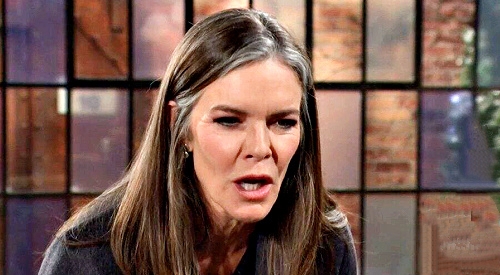
What follows is a masterclass in psychological warfare. Patty casually offers Jack a drink, a gesture of twisted hospitality designed to disorient and dominate. Jack, ever the protector, refuses, but the tension escalates when she reveals a single photograph. It’s Diane, rendered utterly powerless, lying unconscious in a sterile environment. The image strikes Jack like a physical blow, evoking panic, helpless rage, and an almost overwhelming sense of urgency. The psychological weight of seeing the woman he loves reduced to a pawn in Patty’s obsessive game is unbearable.
Patty manipulates Jack’s emotions with surgical precision, reframing Diane’s abduction into a narrative where Diane herself is supposedly unstable. She claims Diane has suffered a catastrophic mental breakdown and is now under psychiatric care, positioning herself as the benevolent savior. The irony is brutal—Patty, a woman with a long history of psychiatric instability and violent behavior, assumes the mantle of guardian while simultaneously gaslighting Jack. The cognitive dissonance of this role reversal intensifies the horror, turning Jack’s home into a battlefield of perception and control.
The stakes escalate further as Patty intertwines their shared past into the present, exploiting Jack’s history with her to blur the lines between obsession and romance. She asserts that Diane will never return to him, insinuating that Jack’s only path to resolution lies through her. The veiled threat she delivers—hinting that Diane’s safety is contingent upon Jack’s compliance—forces him into a psychological straitjacket. Every choice Jack makes is weighed against the potential for catastrophic consequences for the woman he loves.
Jack’s internal struggle is as compelling as it is devastating. He is forced to maintain the façade of acquiescence to Patty’s demands while navigating the moral and emotional quagmire she has created. Each interaction with Patty is a high-wire act, requiring him to suppress natural revulsion and respond with calculated care. He must balance the immediate threat to Diane’s life with the long-term risk to his own sanity and that of his family. Every glance, every word exchanged carries monumental weight, and Jack is acutely aware that a single misstep could result in irreversible tragedy.
The dramatic irony of this scenario heightens the tension. Offscreen, viewers know the truth: Diane is not receiving legitimate care but is instead held captive by Dr. Lawrence Markham, a figure whose involvement amplifies the danger. Markham’s role as a manipulative psychiatrist compounds Diane’s vulnerability, creating a layered narrative where Jack is blind to the full extent of the threat even as he navigates Patty’s demands. The interplay between perception and reality, between coercion and desperation, defines the psychological intensity of the storyline.
The psychological toll extends beyond Jack to the broader Abbott family. He cannot confide in Kyle or Tracy, isolating himself to protect Diane and maintain control over the volatile situation. The burden of deception weighs heavily, forcing Jack to act as both strategist and guardian under extreme duress. The tension between duty and emotion, between survival and morality, drives the narrative forward, making each episode a study in suspense and character complexity.
Patty’s calculated cruelty, coupled with her delusional romantic narrative, positions her as an unstoppable force within Genoa City. Unlike corporate or financial adversaries such as Victor Newman, her actions are motivated purely by obsessive desire, making her unpredictable and nearly impossible to counter. Jack’s predicament exemplifies a battle where logic is ineffective, and the only viable path is tactical compliance, heightening the stakes to near-unbearable levels.
This arc also underscores the enduring consequences of past trauma. Jack’s decades-long entanglement with Patty provides her with intimate knowledge of his vulnerabilities, which she exploits to devastating effect. Every psychological move is informed by history, amplifying the tension and placing Jack in a uniquely perilous position. His struggle is not merely external but deeply internal, requiring him to navigate guilt, fear, and moral ambiguity simultaneously.
For viewers, the storyline delivers a multi-layered emotional experience. It blends suspense with psychological drama, exploring themes of obsession, manipulation, and the fragility of trust. Jack’s journey, forced to feign affection under threat while protecting Diane, showcases a complex moral landscape rarely explored in daytime television with such intensity. The emotional resonance of this narrative is amplified by the high stakes, the intricate character dynamics, and the ever-present threat of irreversible loss.
As the storyline unfolds, every moment is charged with potential catastrophe. Jack’s calculated responses to Patty’s provocations will define the trajectory of the Abbott family’s future, while Diane’s unseen suffering amplifies the stakes and maintains relentless tension. The intersection of past trauma, present danger, and psychological manipulation ensures that viewers remain riveted, anticipating each shocking revelation and dramatic turn.

In conclusion, Patty Williams’ latest manipulations represent one of The Young and the Restless’ most psychologically intense arcs. By turning Jack into a reluctant participant in her delusional game, she forces him into a position of unparalleled moral and emotional complexity. The layered threats, the manipulations of perception, and the profound emotional stakes make this a defining moment for both the Abbott family and Genoa City itself. The weeks ahead promise relentless suspense, intricate character work, and unforgettable television that challenges both its characters and audience in equal measure.
This arc is a masterful blend of psychological terror and emotional drama, cementing Patty Williams’ status as one of daytime television’s most dangerous and compelling figures. Jack Abbott’s response—calculated, desperate, and morally conflicted—ensures that viewers are locked into a high-stakes battle of wits and will, with Diane Jenkins’ safety hanging in the balance. It is, without question, one of the darkest and most gripping chapters in Genoa City’s recent history.