
Willow was killed, Eva’s killer acted to cover their tracks – General Hospital Spoilers
ABC’s General Hospital continues to push its narrative into increasingly dark and psychologically complex territory, as the fallout surrounding Willow Tait, the death of Judge Eva, and the shadowy influence of Brennan escalates into a storyline defined by fear, secrecy, and irreversible consequences. What initially appeared to be another layered Port Charles mystery has now evolved into something far more unsettling—an interconnected web of blackmail, exposure, and the looming possibility that someone will not make it out alive.
At the center of this unfolding crisis is Willow Tait, whose recent choices have placed her in direct conflict with some of the most dangerous forces operating within Port Charles. Her decision to weaponize information tied to Judge Eva’s death and use it as leverage against Brennan marks a significant turning point in her character arc. Once viewed as a figure of resilience and emotional stability, Willow now finds herself operating in moral territory that even seasoned Port Charles players treat with caution.
The revelation surrounding Judge Eva’s death has not brought clarity to the situation—instead, it has intensified the stakes. Willow’s possession of key information has made her both an asset and a liability. In a town where secrets function as currency, her knowledge places her at the center of a dangerous exchange where silence can be bought, but survival is never guaranteed.
Brennan, meanwhile, remains an equally enigmatic figure within this unfolding drama. His connection to the events surrounding Judge Eva’s death raises pressing questions about his true role in the narrative. Is he a man trapped by circumstance, forced into silence by forces beyond his control? Or is he a calculated operator who understands precisely how to survive within systems built on compromise and concealment?
The ambiguity surrounding Brennan only deepens the tension. Each interaction between him and Willow becomes a negotiation of power, trust, and threat. Their dynamic is no longer defined by simple opposition, but by mutual dependency—an uneasy balance in which both parties hold pieces of a truth that could destroy them.
However, the most alarming development emerging from this storyline is not simply the existence of a cover-up, but the suggestion that the original crime—the death of Judge Eva—may have been deliberately staged or manipulated in order to conceal something even more significant. The phrase “covering their tracks” takes on a far more sinister implication when viewed through this lens. It suggests not only concealment, but active elimination of threats.
This raises an unsettling possibility: Willow herself may not be safe.
In classic General Hospital fashion, the narrative begins to shift from investigation to survival. The question is no longer simply who is responsible for Judge Eva’s death, but who will be silenced next in order to keep the truth buried. Willow’s position becomes increasingly precarious as she moves deeper into a game she may not fully control.
Her recent actions—particularly her use of blackmail—underscore a recurring thematic element within the series: the illusion of control in an environment defined by chaos. Blackmail, in this context, is not merely a tool of manipulation; it is a manifestation of desperation. Willow is not operating from a position of strength, but from a need to assert agency in a system that has repeatedly destabilized her sense of identity and moral grounding.
Yet, as history in Port Charles has repeatedly demonstrated, those who attempt to control secrets often become consumed by them.
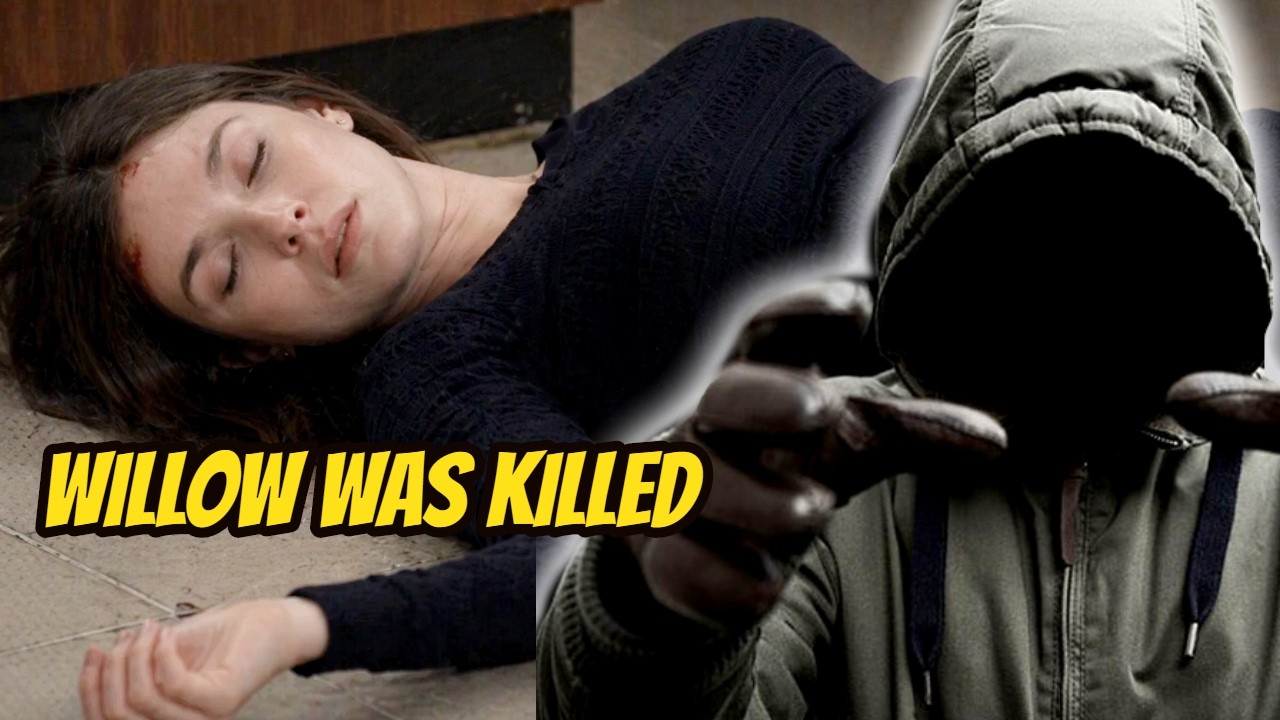
The psychological pressure on Willow intensifies further when considering the potential consequences of exposure. Should Brennan choose to retaliate—or should another party connected to Judge Eva’s death move to eliminate loose ends—Willow could quickly transition from a key player in the investigation to a liability that must be removed.
The possibility of her death, while not confirmed, has begun to circulate within the narrative structure itself as a looming consequence rather than a speculative twist. The storytelling subtly invites viewers to consider a chilling scenario: that Willow may not live long enough to see justice unfold.
This potential trajectory introduces a tragic layer to the already volatile storyline. If Willow were to die before the truth surrounding Judge Eva’s death is fully revealed—or before Drew Cain regains consciousness and can respond to the situation—the emotional and narrative consequences would be profound. It would not simply be a loss of life, but a collapse of unresolved relationships, unfinished confessions, and irreversible misunderstandings.
Drew Cain’s impending recovery further complicates this timeline. His awakening represents the restoration of truth and awareness, but also the possibility of confrontation and reckoning. If Willow’s fate is sealed before Drew regains consciousness, the emotional aftermath would be devastating, transforming what should be a moment of healing into one of absence and regret.
This structural tension—between truth arriving too late and consequences arriving too soon—forms the emotional backbone of the current storyline. It is a classic General Hospital mechanism: truth does not arrive as salvation, but as disruption.
Elsewhere in Port Charles, the broader implications of Judge Eva’s death continue to ripple outward. Brennan’s silence, Willow’s leverage, and the unseen hands potentially orchestrating the cover-up suggest a much larger conspiracy at play. The phrase “covering their tracks” implies coordination, intention, and above all, fear—fear that the truth, if fully exposed, would destabilize multiple power structures within the city.
What makes this storyline particularly compelling is its refusal to provide moral clarity. No character occupies a fully heroic or fully villainous position. Instead, each individual operates within shades of compromise, survival instinct, and emotional damage. Willow’s choices are questionable, but not incomprehensible. Brennan’s silence is suspicious, but not yet fully indictable. Even the concept of justice becomes blurred when filtered through competing motivations.
At its core, this arc reflects one of General Hospital’s most enduring themes: the cost of truth in a world built on secrets. Knowledge does not liberate characters in Port Charles—it isolates them. It endangers them. And in some cases, it marks them for removal.
As the narrative moves forward, the tension surrounding Willow’s fate, Brennan’s involvement, and the unresolved truth behind Judge Eva’s death continues to escalate. The possibility that Willow is being targeted—not just for what she knows, but for what she might reveal—adds a layer of psychological suspense that shifts the storyline from political intrigue to existential threat.
Viewers are left with an increasingly urgent question: is Willow Tait positioned as the next victim in a long chain of Port Charles secrets turned deadly, or is she destined to become the catalyst that finally exposes the truth?
In true General Hospital fashion, the answer is unlikely to be simple, and almost certainly will not come without consequence.
One thing, however, is clear. The cover-up surrounding Judge Eva’s death is no longer just about protecting a secret. It is about protecting survival itself. And in Port Charles, survival often comes at the highest possible cost.