
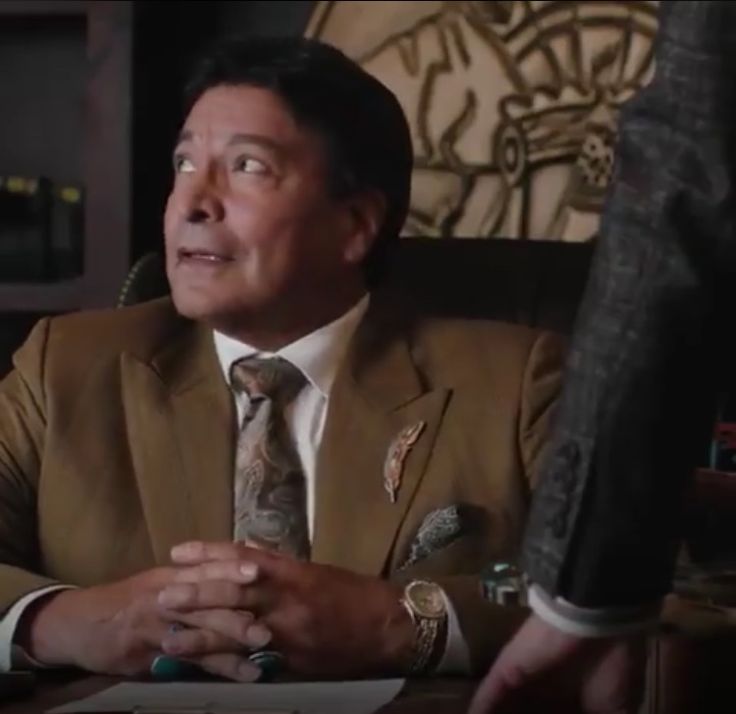
Yellowstone Universe Expands Again: Thomas Rainwater’s Role in Marshals Becomes the Most Powerful Wild Card Yet
A New Layer of Power in the Yellowstone Story
As the Yellowstone universe continues to expand through Marshals, attention is no longer focused solely on Kayce Dutton. One of the most quietly influential figures returning to the spotlight is Thomas Rainwater, whose presence is reshaping the emotional and political balance of the entire storyline.
Unlike traditional law enforcement narratives, Marshals does not operate in isolation from Yellowstone’s deep-rooted conflicts. Instead, it brings them into a broader, more complex system—where tribal leadership, federal authority, and personal history collide.
And at the center of that collision stands Rainwater.
Thomas Rainwater: From Tribal Leader to Strategic Power Player
Thomas Rainwater has always been one of the most intellectually driven characters in the Yellowstone universe. As the leader of the Broken Rock Reservation, he represents more than political authority—he represents long-term strategy in a world dominated by short-term violence.
In Marshals, his role evolves beyond tribal leadership. He becomes a critical voice in cases that extend beyond jurisdictional boundaries, especially those involving crimes that affect Indigenous communities.
What makes Rainwater so compelling in this expanded universe is not just his position, but his perspective. He sees patterns where others see isolated incidents. He understands that what happens in one case often connects to a much larger system of exploitation and power imbalance.
This awareness makes him indispensable—and dangerous in equal measure.
A Bridge Between Law Enforcement and Tribal Sovereignty
One of the most important narrative developments in Marshals is how Rainwater functions as a bridge between federal law enforcement and tribal sovereignty.
Unlike traditional advisors, he is not simply offering cultural context. He is actively shaping how investigations unfold, ensuring that jurisdictional boundaries are respected while still pushing for accountability in cases that affect his people.
This creates tension within the system.
Federal agents often operate under rigid protocols, while Rainwater approaches justice through a lens shaped by history, displacement, and generational trauma. That difference in worldview leads to friction—but also to breakthroughs that would otherwise be impossible.
He is not a supporting character.
He is a strategic force within the narrative structure.
The Emotional Weight Behind His Decisions
While Rainwater is often portrayed as composed and analytical, Marshals subtly reveals the emotional weight behind his decisions. Every case tied to Broken Rock is not just professional—it is deeply personal.
The unresolved trauma of land loss, systemic neglect, and violence against Indigenous communities informs his every interaction. This emotional undercurrent adds depth to his character, making him far more than a political figure.
He is a man carrying history into every negotiation, every investigation, and every confrontation.
And that history never leaves the room.

Relationship With Kayce Dutton: Respect, Tension, and Unspoken Understanding
One of the most compelling dynamics in Marshals is the evolving relationship between Thomas Rainwater and Kayce Dutton. These two men come from fundamentally different worlds, yet they share a rare understanding of violence, responsibility, and consequence.
There is no simple alliance between them.
There is respect—but also tension.
Rainwater sees Kayce as someone shaped by inherited power, while Kayce recognizes Rainwater as someone building power through strategy and patience. Their interactions are often quiet, but layered with implication.
Neither fully trusts the other.
Yet both recognize that in certain situations, cooperation is unavoidable.
This uneasy balance adds narrative depth to every shared scene.
Rainwater’s Role in Expanding the Yellowstone Universe
From a broader franchise perspective, Rainwater’s presence in Marshals signals a major thematic expansion of the Yellowstone universe. While earlier series focused heavily on land ownership and family legacy, Marshals introduces systemic issues involving law enforcement, tribal sovereignty, and federal jurisdiction.
Rainwater sits at the center of that shift.
He represents a worldview that challenges traditional Western narratives of power. Instead of focusing on control through ownership, he focuses on survival through strategy, patience, and institutional understanding.
This makes him one of the most forward-thinking characters in the entire universe.
The Hidden Political Layer of Marshals
As the series progresses, it becomes increasingly clear that Marshals is not just a procedural drama—it is also a political narrative. And Rainwater is one of the key figures shaping that political layer.
His involvement in investigations often reveals deeper systemic issues that go beyond individual crimes. These include:
- Jurisdictional disputes between federal and tribal authorities
- Long-standing corruption affecting marginalized communities
- Cross-border trafficking routes exploiting legal gaps
- Institutional neglect hidden beneath official reports
Rainwater’s insight into these issues elevates the storytelling from simple case-of-the-week structure to a broader commentary on power and accountability.
Emotional Control vs. Historical Pressure
One of Rainwater’s defining traits is his emotional restraint. Unlike many characters in the Yellowstone universe who react impulsively, he operates with deliberate control.
However, Marshals occasionally reveals cracks in that control—not through outbursts, but through silence.
Those moments suggest the immense pressure of carrying historical responsibility while navigating modern systems that were not designed with his community in mind.
It is not a collapse of character.
It is a reminder of burden.
Why Rainwater Matters More in Marshals Than Ever Before
In earlier Yellowstone narratives, Rainwater often operated parallel to the Dutton family conflict. In Marshals, however, he is no longer on the sidelines.
He is inside the system.
This shift significantly increases his narrative importance. He is no longer reacting to events—he is influencing how they unfold. His decisions affect not only Broken Rock, but also federal operations and broader criminal investigations.
That level of integration makes him one of the most important connective figures in the entire franchise.
Conclusion: A Quiet Force Driving a Larger Story
Thomas Rainwater’s role in Marshals represents a different kind of power within the Yellowstone universe. It is not loud. It is not impulsive. It does not rely on physical dominance.
Instead, it is strategic, historical, and deeply informed by long-term consequence.
As Marshals continues to evolve, Rainwater stands as a reminder that power is not only measured in land or violence—but in understanding systems well enough to navigate them.
And in a world where every decision carries ripple effects, that kind of intelligence may be the most dangerous force of all. 🤠🔥